APOTHEOSIS OF HERCULES (HERAKLES)
Everything gathered in one place
Read the full description, review additional information.
APOTHEOSIS OF HERCULES (HERAKLES)
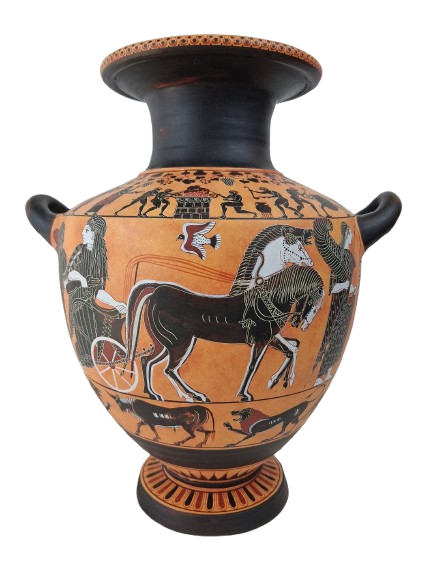
The Caeretan Black-Figure Hydria Ricci titled “Apotheosis of Herakles” is a Caeretan work of the Archaic period, dated between 550 and 500 BCE. The vase, which stands 44.5 cm high, is now housed in the Museo Nazionale Etrusco di Villa Giulia in Rome. It is attributed to the workshop of the so-called “Louvre E 739” painter, a North-Ionian artist active in Etruria during the mid-6th century BCE.
The principal scene on the body depicts the apotheosis of Herakles, that is, his ascent to Olympus after the completion of his labours. The hero is shown in a chariot, accompanied by divine or heroic figures, in a composition that emphasizes triumph and the transition from the mortal to the immortal sphere. The scene belongs to the mythological cycle celebrating the superhuman excellence of Herakles and his final acceptance among the gods.
On the shoulder of the vase runs a second narrative frieze of particular importance, depicting scenes of Greek sacrifice. Youths and men appear in various poses around an altar and ritual vessels, while other figures carry sacrificial animals or take part in the preparation of the offering. This frieze serves as a complementary religious framework to the main scene, linking heroic apotheosis with formal cult practice.
The hydria is distinguished by the strong linearity, vivid chromatic contrast, and decorative precision characteristic of Caeretan pottery. Figures, chariots, animals, and ornamental motifs are arranged in a composition of marked rhythm and clear narrative structure. The vessel is an outstanding example of the way Archaic art combined heroic myth, religious ritual, and decorative richness into a unified iconographic program.
Info
ORDERS
You can order products in the following ways:
- Order after registering as a user - member of our website. In this way you will have the advantages of tracking your order, searching for order history, managing favorite products, etc. (temporarily unavailable)
- Complete your order without registering. In this case, we will know you as a customer, but you will not have the facilities that members of our online store have.
- Do it by phone or email. You can place your order by phone at ++30 6976442097 daily (Monday – Friday) from 09:00 a.m. to 10.00 p.m. Greek time (07.00 – 20.00 UTC), or by email at order@aethlion.gr. Please note the code and price of the products you wish to order. and Pay by Deposit our Bank Account.
PAYMENT METHODS
In our online store you can pay with the following payment methods.
CREDIT, DEBIT OR PREPAID CARDS
For your best possible security and service, our eShop uses the secure Stripe payment platform.
Through Stripe, you can complete your purchase in the following ways:
- Credit and Debit Cards (Visa, Mastercard, American Express)
- Apple Pay and Google Pay (when supported by your device)
- Stripe Link – for quick one-click payments (for users who already have a Link account)
All payments are made with high-level encryption (PCI DSS Level 1), without ever storing payment details on the servers of our eShop.
In addition, for your protection, the European PSD2 Directive applies and 3D Secure technology is supported where required.
In this way, we ensure completely safe and reliable transactions.
To enter your card details, you are transferred to the secure STRIPE system and after successful payment you return to our online store.
DEPOSIT TO A BANK ACCOUNT (EU Transactions)
When depositing in the transaction comments, please include the relevant order number or product code and your last name. The deposit can be made to the following bank account:
NATIONAL BANK: GR2201106690000066900920027 BENEFICIARY: AETHLION PC
For your faster service, after deposit, please let us know. Send us the copy of the bank payment order (extrait) or the date, the bank and the amount of your deposit by e-mail to order@aethlion.gr or let us know by SMS at ++30 6976442097 (also Viber). As soon as we have identified your payment, we will immediately send you an order confirmation and initiate the shipment of your order.
ORDER CANCELLATION
Contact us at ++30 6976442097 daily (Monday – Friday) from 09:00 a.m. to 10.00 p.m. Greek time (07.00 – 20.00 UTC). or email at returns@aethlion.gr to see if it is feasible (the shipping process has not started yet) and what the cancellation process will be.
PACKAGING: We only offer sustainable, handcrafted artworks, and our packaging is safely and fully recyclable.
GIFTS: If you choose this artwork as a gift, we will package it according to your preferences for the recipient, with a cost value debit.
SHIPPING METHODS
Orders are shipped with Hellenic Post, Greek private courier companies, and in special cases (extra charge) with UPS and DHL. Also, orders worth up to €100 can be delivered to the BOXNow network (Greece & some EU countries).
All orders are shipped within the next 1-3 business days from the date of their confirmation, as long as they are immediately available. Once your order has been shipped, you will receive a confirmation e-mail.
DELIVERY
For shipments to Attica, delivery is usually made on the next working day. In the rest of the Greek areas they are delivered in 2-5 working days.
For Overseas Shipments
For shipments to countries within Europe, delivery is usually made in 5-15 business days, as well as for shipments outside Europe delivery is usually made in 10-25 business days.
We provide simple shipping with HELLENIC POST with trucking number Monday to Friday.
The shipment is shipped within 48 hours after payment is confirmed.
PLEASE NOTE import duties, taxes and charges for purchases outside the EU are not included in the price of the item and are the responsibility of the buyer. The corresponding customs clearance times are not the subject of determining the timing of the shipment. For this reason, contact the customs office of your country to determine what the additional costs will be and the time required before purchasing the product.
RETURNS AND EXCHANGE POLICY
Please contact us before returning any product by phone ++30 6976442097 or returns@ aethlion.gr (AETHLION PC, AETHLION PC)
WITHDRAWAL
Right of withdrawal of EU citizens, or in the European internal market.
As long as you are a natural person acting as a consumer (and only), you have the right to withdraw from this contract within 14 calendar days without giving any explanation.
PRODUCTS WITH ACTUAL DEFECT OR LACK OF AGREED QUALITY (EU)
Please check your order upon receipt and contact us immediately if the product is defective, damaged, or if you receive the wrong product so that we can assess the issue and correct it.
We invite you to contact us within 48 hours of receiving it, at ++30 6976442097 or send an email to returns@ aethlion.gr (including photos) in order to discuss this issue.
PRODUCT CHANGE (EU)
In case there is no defect or lack of agreed quality in the product you received, you simply wish to change it and replace it with another product of equal, lower or higher value, we invite you to contact us within 48 hours of receiving it at ++30 6976442097 or send an email to returns@ aethlion.gr (including photos) in order to consult on this issue and replace it with another product of your preference.
CUSTOMIZED AND PERSONALIZED ORDERS
Custom and personalized orders cannot be returned and replaced.
RETURN CONDITIONS
Necessary conditions for your application to be accepted are for each product to be returned to:
- It is in its original excellent condition, intact and unused, inside its packaging.
- It has been received, audited and approved by the company.
- It must be accompanied by the original receipt and all other purchase documents.
- It is not already changed.
If the value of the new order is lower than the value of the original order, the company will not refund you the difference. This difference will be credited to the customer's name for future purchases.
RETURNS AND CANCELLATIONS FOR NON-EU CUSTOMERS and EU NON-INDIVIDUALS
Returns and Cancellations are accepted in case (error or omission on our part) of a damaged or broken item during transport and in no case that the buyer does not indicatively agree with the dimensions, colors or materials of the item, or the visual representation (within 48 hours of receiving it)
Non-EU customers and EU NON-INDIVIDUALS can request the replacement of the product with another product of the company. In this case, you are responsible for:
- The costs of transporting the products.
- Insurance costs.
- Customs clearance costs for countries outside the European Union.
You can find detailed ESHOP POLICIES aethlion.gr(Last updated: 6 June 2025) at Terms & Conditions https://aethlion.gr/Rules/Index
The policies of eShop aethlion.gr (which belongs to the company AETHLION PC, TAX IDENTIFICATION NUMBER 802640230, KEFODE ATTIKIS) are as follows:
PRODUCT AND SERVICE QUALITY POLICIES
INVOICING, ORDERING AND PAYMENT POLICY
TRANSPORT AND DELIVERY POLICY
RETURNS AND EXCHANGE POLICY
TERMS AND CONDITIONS OF USE ESHOP
PRIVACY POLICY – PERSONAL DATA
ΠΑΡΑΓΓΕΛΊΕΣ
Μπορείτε να παραγγείλετε προϊόντα με τους ακόλουθους τρόπους:
- Παραγγελία μετά την εγγραφή σας ως χρήστης - μέλος της ιστοσελίδας μας. Με αυτόν τον τρόπο θα έχετε τα πλεονεκτήματα της παρακολούθησης της παραγγελίας σας, της αναζήτησης ιστορικού παραγγελιών, της διαχείρισης αγαπημένων προϊόντων κ.λπ. (προσωρινά μη διαθέσιμο)
- Ολοκληρώστε την παραγγελία σας χωρίς εγγραφή. Σε αυτή την περίπτωση, θα σας γνωρίζουμε ως πελάτη, αλλά δεν θα έχετε τις διευκολύνσεις που έχουν τα μέλη του ηλεκτρονικού μας καταστήματος.
- Κάντε το μέσω τηλεφώνου ή email. Μπορείτε να κάνετε την παραγγελία σας τηλεφωνικά στο ++30 6976442097 καθημερινά (Δευτέρα – Παρασκευή) από τις 09:00 π.μ. έως τις 10.00 μ.μ. Ώρα Ελλάδας (11.00 – 20.00 UTC), ή μέσω email στις order@aethlion.gr. Παρακαλούμε σημειώστε τον κωδικό και την τιμή των προϊόντων που θέλετε να παραγγείλετε. και Πληρωμή με Κατάθεση του Τραπεζικού μας Λογαριασμού.
ΤΡΟΠΟΙ ΠΛΗΡΩΜΗΣ
Στο ηλεκτρονικό μας κατάστημα μπορείτε να πληρώσετε με τους παρακάτω τρόπους πληρωμής.
ΠΙΣΤΩΤΙΚΈΣ, ΧΡΕΩΣΤΙΚΈΣ Ή ΠΡΟΠΛΗΡΩΜΈΝΕΣ ΚΆΡΤΕΣ
Για την καλύτερη δυνατή ασφάλεια και εξυπηρέτησή σας, το ηλεκτρονικό μας κατάστημα χρησιμοποιεί την ασφαλή πλατφόρμα πληρωμών Stripe.
Μέσω του Stripe, μπορείτε να ολοκληρώσετε την αγορά σας με τους ακόλουθους τρόπους:
- Πιστωτικές και χρεωστικές κάρτες (Visa, Mastercard, American Express)
- Apple Pay και Google Pay (όταν υποστηρίζονται από τη συσκευή σας)
- Stripe Link – για γρήγορες πληρωμές με ένα κλικ (για χρήστες που έχουν ήδη λογαριασμό Link)
Όλες οι πληρωμές γίνονται με κρυπτογράφηση υψηλού επιπέδου (PCI DSS Level 1), χωρίς ποτέ να αποθηκεύονται τα στοιχεία πληρωμής στους διακομιστές του ηλεκτρονικού μας καταστήματος.
Επιπλέον, για την προστασία σας, ισχύει η ευρωπαϊκή οδηγία PSD2 και υποστηρίζεται η τεχνολογία 3D Secure όπου απαιτείται.
Με αυτόν τον τρόπο, εξασφαλίζουμε απόλυτα ασφαλείς και αξιόπιστες συναλλαγές.
Για να εισάγετε τα στοιχεία της κάρτας σας, μεταφέρεστε στο ασφαλές σύστημα STRIPE και μετά την επιτυχή πληρωμή επιστρέφετε στο ηλεκτρονικό μας κατάστημα.
ΚΑΤΆΘΕΣΗ ΣΕ ΤΡΑΠΕΖΙΚΌ ΛΟΓΑΡΙΑΣΜΌ
Κατά την κατάθεση στα σχόλια της συναλλαγής, συμπεριλάβετε τον σχετικό αριθμό παραγγελίας ή τον κωδικό προϊόντος και το επώνυμό σας. Η κατάθεση μπορεί να γίνει στον ακόλουθο τραπεζικό λογαριασμό: ΕΘΝΙΚΗ ΤΡΑΠΕΖΑ: GR2201106690000066900920027 ΔΙΚΑΙΟΥΧΟΣ: ΑEΘΛΙΟN ΙΚΕ
Για την ταχύτερη εξυπηρέτησή σας, μετά την κατάθεση, παρακαλούμε ενημερώστε μας. Στείλτε μας το αντίγραφο της τραπεζικής εντολής πληρωμής (extrait) ή την ημερομηνία, την τράπεζα και το ποσό της κατάθεσής σας με e-mail στο order@aethlion.gr ή ενημερώστε μας με SMS στο ++30 6976442097 (επίσης Viber). Μόλις προσδιορίσουμε την πληρωμή σας, θα σας στείλουμε αμέσως μια επιβεβαίωση παραγγελίας και θα ξεκινήσουμε την αποστολή της παραγγελίας σας.
ΑΚΥΡΩΣΗ ΠΑΡΑΓΓΕΛΙΑΣ
Επικοινωνήστε μαζί μας στο ++30 6976442097 καθημερινά (Δευτέρα – Παρασκευή) από τις 09:00 π.μ. έως τις 10.00 μ.μ. ώρα Ελλάδας (07.00 – 20.00 UTC). ή στείλτε email στο returns@aethlion.gr για να δείτε αν είναι εφικτό (η διαδικασία αποστολής δεν έχει ξεκινήσει ακόμα) και ποια θα είναι η διαδικασία ακύρωσης.
ΣΥΣΚΕΥΑΣΙΑ: Προσφέρουμε μόνο βιώσιμα, χειροποίητα έργα τέχνης και οι συσκευασίες μας είναι ασφαλείς και πλήρως ανακυκλώσιμες.
ΔΩΡΑ: Εάν επιλέξετε αυτό το έργο τέχνης ως δώρο, θα το συσκευάσουμε σύμφωνα με τις προτιμήσεις σας για τον παραλήπτη, με χρέωση αξίας κόστους.
ΤΡΟΠΟΙ ΑΠΟΣΤΟΛΗΣ
Οι παραγγελίες αποστέλλονται με τα Ελληνικά Ταχυδρομεία, ελληνικές ιδιωτικές εταιρείες ταχυμεταφορών και σε ειδικές περιπτώσεις (επιπλέον χρέωση) με την UPS και την DHL. Επίσης, παραγγελίες αξίας έως €100 μπορούν να παραδοθούν στο δίκτυο της BOXNow (Ελλάδα).
Όλες οι παραγγελίες αποστέλλονται εντός των επόμενων 1-3 εργάσιμων ημερών από την ημερομηνία επιβεβαίωσής τους, εφόσον είναι άμεσα διαθέσιμες. Μόλις αποσταλεί η παραγγελία σας, θα λάβετε ένα e-mail επιβεβαίωσης.
ΠΑΡΆΔΟΣΗ
Για αποστολές εντός Αττικής, η παράδοση γίνεται συνήθως την επόμενη εργάσιμη ημέρα. Στις υπόλοιπες περιοχές της Ελλάδας παραδίδονται σε 2-5 εργάσιμες ημέρες.
Για αποστολές στο εξωτερικό
Για αποστολές σε χώρες εντός Ευρώπης, η παράδοση γίνεται συνήθως σε 5-15 εργάσιμες ημέρες, καθώς και για αποστολές εκτός Ευρώπης η παράδοση γίνεται συνήθως σε 10-25 εργάσιμες ημέρες.
Παρέχουμε απλή αποστολή με τα ΕΛΤΑ με αριθμό παράδοσης από Δευτέρα έως Παρασκευή.
ΣΗΜΕΙΩΣΗ Οι εισαγωγικοί δασμοί, οι φόροι και οι χρεώσεις για αγορές εκτός της ΕΕ δεν περιλαμβάνονται στην τιμή του προϊόντος και αποτελούν ευθύνη του αγοραστή. Οι αντίστοιχοι χρόνοι εκτελωνισμού δεν αποτελούν αντικείμενο καθορισμού του χρονοδιαγράμματος της αποστολής. Για το λόγο αυτό, επικοινωνήστε με το τελωνείο της χώρας σας για να καθορίσετε ποιο θα είναι το πρόσθετο κόστος και ο χρόνος που απαιτείται πριν από την αγορά του προϊόντος.
ΠΟΛΙΤΙΚΗ ΕΠΙΣΤΡΟΦΩΝ ΚΑΙ ΑΛΛΑΓΗΣ
Παρακαλούμε επικοινωνήστε μαζί μας πριν επιστρέψετε οποιοδήποτε προϊόν τηλεφωνικά ++30 6976442097 ή returns@ aethlion.gr (AETHLION PC, AETHLION PC)
ΥΠΑΝΑΧΩΡΗΣΗ
Δικαίωμα υπαναχώρησης πολιτών της ΕΕ ή στην ευρωπαϊκή εσωτερική αγορά.
Εφόσον είστε φυσικό πρόσωπο που ενεργεί ως καταναλωτής (και μόνο), έχετε το δικαίωμα να υπαναχωρήσετε από την παρούσα σύμβαση εντός 14 ημερολογιακών ημερών χωρίς να δώσετε καμία εξήγηση.
ΠΡΟΪΟΝΤΑ ΜΕ ΠΡΑΓΜΑΤΙΚΟ ΕΛΑΤΤΩΜΑ Ή ΕΛΛΕΙΨΗ ΣΥΜΦΩΝΙΑΣ ΠΟΙΟΤΗΤΑΣ (EU)
Ελέγξτε την παραγγελία σας κατά την παραλαβή και επικοινωνήστε μαζί μας αμέσως εάν το προϊόν είναι ελαττωματικό, κατεστραμμένο ή εάν λάβετε λάθος προϊόν, ώστε να μπορέσουμε να αξιολογήσουμε το πρόβλημα και να το διορθώσουμε.
Σας προσκαλούμε να επικοινωνήσετε μαζί μας εντός 48 ωρών από την παραλαβή του, στο ++30 6976442097 ή να στείλετε ένα email στο returns@ aethlion.gr (συμπεριλαμβανομένων φωτογραφιών) για να συζητήσουμε αυτό το θέμα.
ΑΛΛΑΓΗ ΠΡΟΪΟΝΤΟΣ (EU)
Σε περίπτωση που δεν υπάρχει ελάττωμα ή έλλειψη συνομολογημένης ιδιότητας στο προϊόν που παραλάβατε, απλά επιθυμείτε να το αλλάξετε και να το αντικαταστήσετε με άλλο προϊόν ίσης, μικρότερης ή μεγαλύτερης αξίας, σας καλούμε να επικοινωνήσετε μαζί μας εντός 48 ωρών από την παραλαβή του στο +30 6976442097 ή να στείλετε email στο returns@ aethlion.gr (συμπεριλαμβανομένων φωτογραφιών) προκειμένου να συμβουλευτείτε το θέμα αυτό και να το αντικαταστήσετε με άλλο προϊόν της προτίμησής σας.
ΕΞΑΤΟΜΙΚΕΥΜΈΝΕΣ ΚΑΙ ΠΡΟΣΑΡΜΟΣΜΈΝΕΣ ΠΑΡΑΓΓΕΛΊΕΣ
Οι προσαρμοσμένες και εξατομικευμένες παραγγελίες δεν μπορούν να επιστραφούν και να αντικατασταθούν.
ΟΡΟΙ ΕΠΙΣΤΡΟΦΗΣ
Απαραίτητες προϋποθέσεις για να γίνει δεκτή η αίτησή σας είναι κάθε προϊόν να επιστραφεί σε:
- Βρίσκεται στην αρχική του άριστη κατάσταση, άθικτο και αχρησιμοποίητο, μέσα στη συσκευασία του.
- Έχει παραληφθεί, ελεγχθεί και εγκριθεί από την εταιρεία.
- Πρέπει να συνοδεύεται από την πρωτότυπη απόδειξη και όλα τα υπόλοιπα παραστατικά αγοράς.
- Δεν έχει ήδη αλλάξει.
Εάν η αξία της νέας παραγγελίας είναι μικρότερη από την αξία της αρχικής παραγγελίας, η εταιρεία δεν θα σας επιστρέψει τη διαφορά. Αυτή η διαφορά θα πιστωθεί στο όνομα του πελάτη για μελλοντικές αγορές.
ΕΠΙΣΤΡΟΦΕΣ ΚΑΙ ΑΚΥΡΩΣΕΙΣ ΓΙΑ ΠΕΛΑΤΕΣ ΕΚΤΟΣ ΕΕ και ΜΗ ΙΔΙΩΤΕΣ ΤΗΣ ΕΕ
Επιστροφές και Ακυρώσεις γίνονται δεκτές σε περίπτωση (λάθος ή παράλειψη εκ μέρους μας) κατεστραμμένου ή σπασμένου αντικειμένου κατά τη μεταφορά και σε καμία περίπτωση που ο αγοραστής δεν συμφωνεί ενδεικτικά με τις διαστάσεις, τα χρώματα ή τα υλικά του είδους, ή την οπτική αναπαράσταση (εντός 48 ωρών από την παραλαβή του)
Πελάτες εκτός ΕΕ και ΜΗ ΙΔΙΏΤΕΣ ΤΗΣ ΕΕ μπορούν να ζητήσουν την αντικατάσταση του προϊόντος με άλλο προϊόν της εταιρείας. Σε αυτή την περίπτωση, είστε υπεύθυνοι για:
- Τα έξοδα μεταφοράς των προϊόντων.
- Κόστος ασφάλισης.
- Έξοδα εκτελωνισμού για χώρες εκτός Ευρωπαϊκής Ένωσης.
Μπορείτε να βρείτε αναλυτικές ΠΟΛΙΤΙΚΕΣ ESHOP aethlion.gr (Τελευταία ενημέρωση: 6 Ιουνίου 2025) στους Όρους &; Προϋποθέσεις https://aethlion.gr/Rules/Index
Οι πολιτικές του eShop aethlion.gr (το οποίο ανήκει στην εταιρεία ΑΕΘΛΙΟΝ ΙΚΕ, ΑΦΜ 802640230, ΚΕΦΟΔΕ ΑΤΤΙΚΗΣ) έχουν ως εξής:
ΠΟΛΙΤΙΚΕΣ ΠΟΙΟΤΗΤΑΣ ΠΡΟΪΟΝΤΩΝ ΚΑΙ ΥΠΗΡΕΣΙΩΝ
ΠΟΛΙΤΙΚΗ ΤΙΜΟΛΟΓΗΣΗΣ, ΠΑΡΑΓΓΕΛΙΑΣ ΚΑΙ ΠΛΗΡΩΜΗΣ
ΠΟΛΙΤΙΚΗ ΜΕΤΑΦΟΡΑΣ ΚΑΙ ΠΑΡΑΔΟΣΗΣ
ΠΟΛΙΤΙΚΗ ΕΠΙΣΤΡΟΦΩΝ ΚΑΙ ΑΛΛΑΓΗΣ
ΟΡΟΙ ΚΑΙ ΠΡΟΫΠΟΘΕΣΕΙΣ ΧΡΗΣΗΣ ESHOP
ΠΟΛΙΤΙΚΗ ΑΠΟΡΡΗΤΟΥ – ΠΡΟΣΩΠΙΚΑ ΔΕΔΟΜΕΝΑ