RANSOM OF ACHILLES
Everything gathered in one place
Read the full description, review additional information.
RANSOM OF ACHILLES
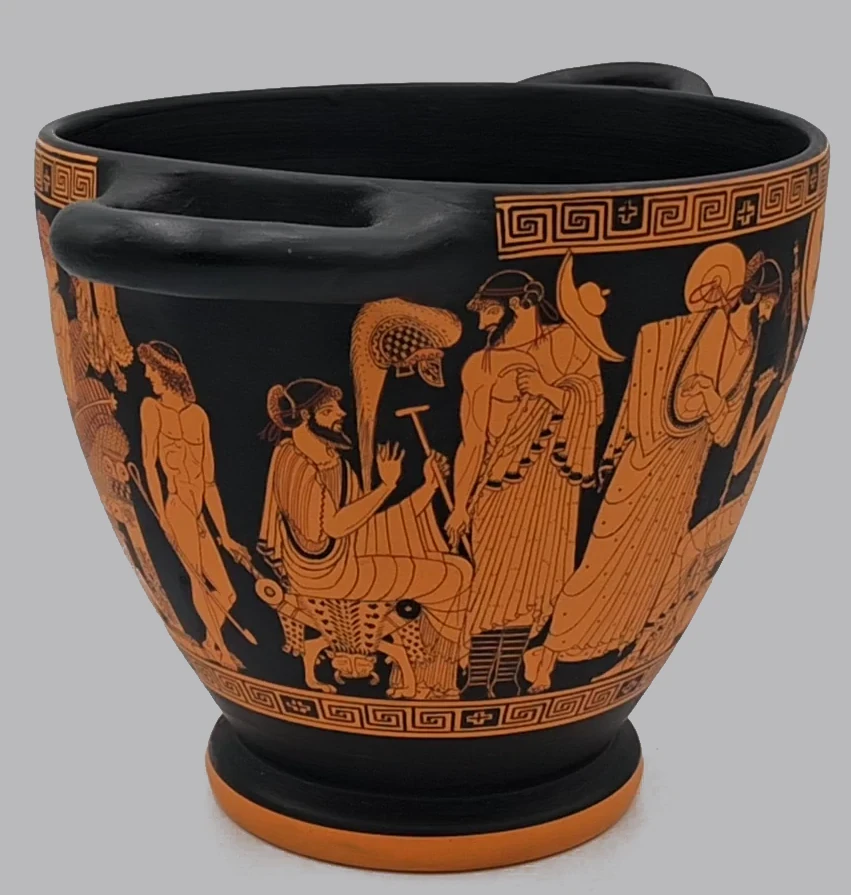
An Attic red-figure skyphos, dating to the early 5th century BC (c. 500–480 BC), depicting an episode from the Trojan War and attributed to the celebrated Brygos Painter. The original vessel was produced in Athens, discovered at Cerveteri (ancient Caere) in Etruria, and is preserved in the Kunsthistorisches Museum in Vienna, under inventory number IV 3710. Its decoration was executed in the red-figure technique, allowing for the detailed rendering of figures, drapery and facial expressions.
The principal side depicts the poignant scene of Priam's ransom of Hector's body, inspired by Book XXIV of Homer's Iliad. Achilles reclines upon an elaborately decorated couch, beneath which lies the lifeless body of Hector. Before him stands the elderly Priam, accompanied by attendants carrying precious gifts as ransom for the return of his dead son. The composition captures with remarkable dramatic intensity the contrast between the victorious warrior's anger and the grieving father's anguish. Suspended weapons and a shield bearing a Gorgoneion complete the scene.
The reverse depicts a gathering of Greek warriors, standing or seated, surrounded by military equipment and shields decorated with animal emblems. The exceptional artistic skill of the Brygos Painter is reflected in the natural poses, delicate linework and expressive character of the figures. The Ransom of Hector represents one of the most significant artistic interpretations of the Homeric epic, conveying timeless values of human dignity, compassion and reconciliation